
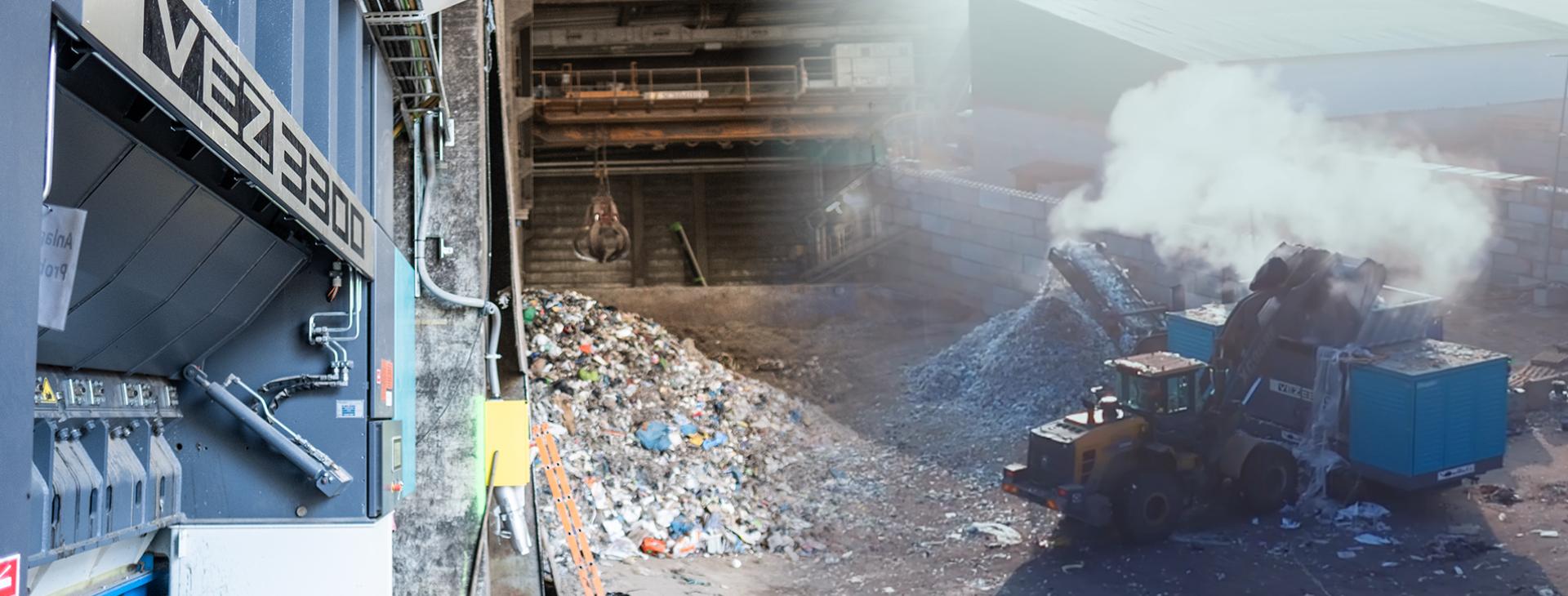
Sometimes it is household waste, sometimes commercial waste, sometimes waste wood or biomass – and sometimes all of these at once. For operators, this therefore raises not only a technical but, above all, an economic question: how can this material be processed reliably, efficiently and without unnecessary costs?
This is precisely where it becomes clear that mobile shredders and stationary shredders fulfil different requirements. With the VEZ 3300 and its mobile variant, the VEZ 3300 e-mobil, two solutions are available that are based on the same technical platform but are designed for different operational approaches.
The crucial question is therefore not: Which shredder is fundamentally better? But rather: Which solution is better suited to my material flow?
The stationary VEZ 3300 is designed as a permanently integrated crushing plant for continuous processes: the material is transported to the machine and processed there on a continuous basis. The mobile version takes a different approach. As a mobile crushing plant, the VEZ 3300 e-mobil goes directly to the material – not the other way round. It is precisely this shift that transforms logistics and, consequently, the cost-effectiveness of an operation.

The VEZ 3300 e-mobil: Why flexibility is a real economic factor
In many businesses, the biggest costs do not arise from the crushing process itself, but in the lead-up to it: through transport, handling, temporary storage and material handling. This is precisely where the VEZ 3300 e-mobil comes into its own. As a mobile shredder, it is deployed where the material is generated – not just where a stationary shredding plant is installed. This reduces transport distances, saves time and lowers operating costs. Mobile shredding really comes into its own, particularly for changing locations or temporary projects – without the need for complex logistics planning.


The technical features of the mobile crusher
The VEZ 3300 e-mobil is designed to deliver its benefits as a mobile shredding unit even under demanding conditions. The tracked undercarriage allows for secure positioning on uneven terrain, whilst a foldable conveyor belt facilitates transport and saves space. An optional automatically adjustable counter blade ensures that the cutting gap remains optimally set at all times. This stabilises output quality whilst reducing wear.
Plug and play instead of a building site: the key time-saving advantage
A key difference between mobile and stationary crushers lies in the commissioning process. The VEZ 3300 e-mobil requires no foundations, no civil engineering work and no complex installation. The machine is simply set up, connected to the mains, and is ready for use in no time.
In practice, plug-and-play means: no lengthy construction phases, no additional infrastructure costs due to permits, and no downtime between planning and the start of production. For companies that need to respond flexibly to new requirements, this is a clear advantage over a permanently installed shredding plant.
Perhaps the most important point: no reliance on diesel
A key advantage of the VEZ 3300 e-mobil is its drive system. Whilst many mobile shredders still operate on diesel, this solution utilises the fully electric Vecoplan HiTorc drive. This significantly reduces energy costs whilst also minimising mechanical wear and tear.
The reason: the electric drive does not require traditional mechanical transmission elements such as belts, couplings or gearboxes. The torque is transmitted directly to the rotor shaft. Compared to conventional electromechanical systems, this allows energy savings of up to 40%.
Furthermore, fully electric operation means there are no local emissions. This allows the mobile shredder to be used even in indoor facilities or sensitive environments. Both the mobile and stationary VEZ 3300 variants also operate noticeably more quietly thanks to the low-noise HiTorc drive.
Advantages of the mobile crusher
- Safe operation even on uneven terrain thanks to the crawler track
- Easier transport with minimal space requirements thanks to the foldable conveyor belt
- Quick commissioning without the need for foundations or civil engineering work thanks to Plug & Play
- Fully electric drive with no reliance on diesel
By switching from diesel to electricity, you can reduce operating costs, expand your range of applications and, at the same time, improve your environmental and site performance.
Same performance, same technology – but greater flexibility
When deciding between mobile and stationary shredders, one factor is particularly important: the mobile and stationary versions of the VEZ 3300 do not differ in terms of performance. Both utilise the same robust machine platform and achieve a throughput of up to 80 tonnes per hour.
The choice between a mobile and a stationary shredding plant is therefore not a question of performance, but of process strategy.

Less downtime thanks to digital intelligence
The Vecoplan Smart Center is available as an option for all VEZ 3300 models. Acting as a digital nervous system, the system aggregates operational data in real time and provides transparency regarding the condition of the shredder.
The system detects foreign objects at an early stage, stops the rotor in the event of anomalies, and thus protects the plant from damage. At the same time, the condition of the blades and counter-blades is continuously analysed, allowing wear to be managed not just reactively but proactively. Maintenance can be scheduled before unplanned downtime occurs.
In addition, Remote Service enables direct remote diagnosis by technicians – without the need for on-site visits and without unnecessary production interruptions.
Quick check: Which shredding solution is right for you?
In practice, a quick reality check is often more helpful than a lengthy analysis. After all, there is rarely just one right solution – what matters is which crushing solution best suits your business, your material flows and your processes.
The following points will help you better understand your requirements and find the right solution, whether it be a mobile or stationary crusher.
Your classification
If you find that the first few points apply to you, you will generally benefit from mobile shredders and quick-deployment solutions such as the VEZ 3300 e-mobil. If, on the other hand, your focus is more on fixed processes and existing infrastructure, a stationary shredding plant is often the more cost-effective choice.
And if you find yourself in several of these areas? Then it’s worth taking a closer look at the combination of our process solutions – please feel free to get in touch for a personalised consultation via our contact form.
Flexibility and place of work
☐ Your materials are generated at multiple or changing locations
☐ Transport and material handling are time-consuming and stressful
☐ You work on a project basis or under frequently changing operating conditions
In this case, flexibility becomes a crucial factor.
Infrastructure and commissioning
☐ You want to get started without a lengthy construction phase
☐ You want to avoid foundation work or building alterations
☐ You need a solution that can be up and running at short notice
Plug and Play offers a clear advantage for you.
Energy and running costs
☐ Energy costs play a significant role in your calculations
☐ You want to reduce your dependence on diesel prices
☐ Emissions and operating conditions are important to you
Fully electric drive systems such as the Vecoplan HiTorc offer you significant advantages.
Process reliability and maintenance
☐ Downtime has a direct impact on your productivity
☐ You want to plan maintenance rather than react to breakdowns
☐ Transparency regarding machine data is important to you
Digital solutions such as the Vecoplan Smart Center are designed to help you with exactly this.
Traditional plant layout
☐ Your material is collected centrally
☐ Your processes run continuously at a single site
☐ You already have an established infrastructure
☐ You are planning for the long term with a stable workload
A stationary crusher is the ideal solution for you.
Conclusion: Two machines – two strategies
The VEZ 3300 is not simply a shredder available in two versions. It is a system that allows for two different operating strategies. The stationary solution offers maximum continuity and integration into existing plant structures. The mobile version offers flexibility, independence and cost-effective shredding directly at the site where the material is located.
Put simply:
Stationary crushers are worthwhile when the material comes to the machine.
Mobile crushers are worthwhile when the machine has to go to the material.
What if the answer isn’t ‘either/or’?
In practice, the decision isn’t always clear-cut. Many operators therefore deliberately avoid an ‘either/or’ approach, opting instead to combine stationary crushers with mobile crushers.
A stationary shredding plant handles the continuous base load. A mobile solution such as the VEZ 3300 e-mobil is deployed specifically where additional flexibility or capacity is required.
This can be useful, for example:
- during seasonal or project-related peaks in demand, when additional capacity is needed at short notice without having to modify the existing plant.
- to safeguard production, when a mobile machine is required to act as a backup during maintenance or overhauls on the stationary plant.
- for greater flexibility in material handling, when problematic or particularly heterogeneous fractions are pre-shredded using a mobile unit before entering the stationary line. This stabilises the overall process and reduces peak loads.
- As a strategic addition to open up new sites, implement projects or initially gather experience before investing in stationary infrastructure.
The advantage of this combination is clear: it creates additional capacity without requiring immediate high investment in infrastructure, whilst simultaneously increasing the reliability of the entire operation.


